
Harnessing Anaerobic Digestion For Biogas Production In Nigeria
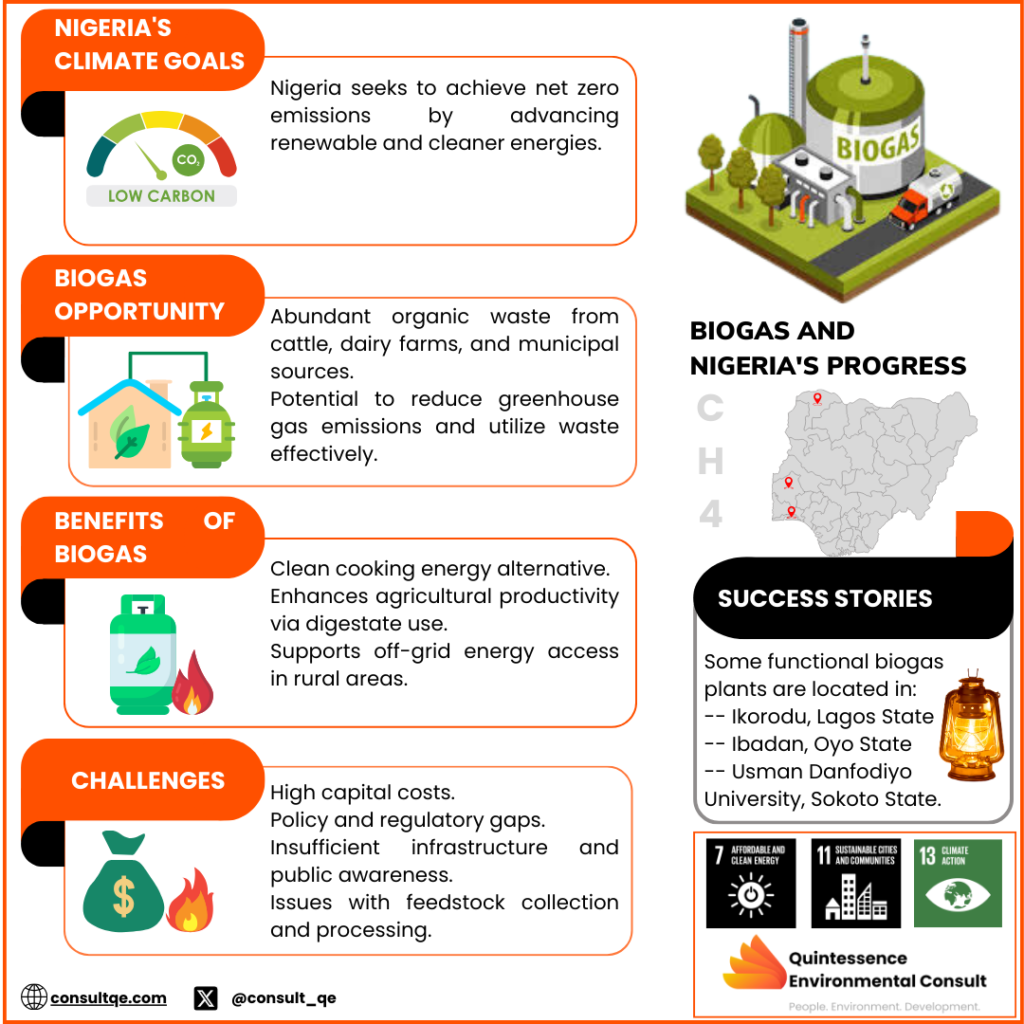
KEY TAKEAWAYS: Nigeria’s reliance on fossil fuel generated GHG emissionsof 100.389MT CO2 in the year 2022, ranking Nigeria to be 4th largest emitter of carbon in Africa. Anaerobic digesters are a great innovation for the country’s renewable energy options. Nigeria has abundant sources of organic waste suitable for biogas production. For instance cattle waste alone has the potential of yielding about 25.53 billion cubic meters of biogas about 169 541.66 MWh of electricity and 88.19 million tons of bio-fertilizer per annum. Biogas production offers diverse advantages, including reducing greenhouse gas emissions, providing clean cooking energy, improving agricultural productivity through digestate use, and supporting off-grid energy access for rural communities. Various projects, such as the biogas plants in Ikorodu-Lagos State, Ibadan-Oyo State, and Usman Danfodiyo University-Sokoto State, demonstrate the feasibility of biogas technology. Biogas production in Nigeria faces barriers like high capital costs, policy and regulatory gaps, lack of infrastructure, limited public awareness, and challenges with feedstock collection and processing. 2. OVERVIEW Nigeria is heavily reliant on fossil fuels, primarily oil, because it is one of the largest oil producers in Africa, with proven reserves of 37.50 billion barrels and a production capacity of approximately 2.19 million barrels per day (mbpd).13 Majority of its government revenue and export earnings come directly from crude oil sales, making its economy heavily dependent on this resource. Heavy dependence on fossil fuels due to its economic value creates significant environmental concerns. Fossil fuels account for more than 65% of the country’s greenhouse gas emissions, with an alarming GHG emissions of 100.389MT CO2 in the year 2022, ranking Nigeria to be 4th largest emitter of carbon in africa.10 As Nigeria takes strides toward achieving its climate and energy transition goals under the Paris Agreement, reducing this dependency will be critical for sustainability and energy security. Biogas produced from the anaerobic digestion of organic matter offers a plethora of benefits for Nigeria’s energy mix; due to its renewable and clean energy resource. In this report, we will explore the transformative potential of harnessing this technology to play a pivotal role in waste management and renewable energy production, offering a sustainable solution to environmental issues in Nigeria. SO, WHAT IS ANAEROBIC DIGESTION? Let’s first talk about Organic Matter. Organic matter comprisesorganic compounds resulting from the remains of decomposed previously living organisms such as plants and animals, and their waste products. Major sources of organic material for anaerobic digestion include dairy manure, food processing waste, plant residues, municipal wastewater, food waste, fats, oils, and grease. Anaerobic digestion (AD) is a biotechnological process that uses the diverse population of microorganisms to decompose organic matter in the absence of oxygen, resulting in the production of biogas—a renewable energy source primarily composed of methane (CH₄). The biotechnological process involves four stages: Hydrolysis, acidogenesis, Acetogenesis and Methanogenesis.10 The transformation of organic matter into biogas unveils anaerobic digesters as an environmentally sustainable and eco-friendly energy solution. BACKGROUND INFORMATION Nigeria’s commitments under the Paris Agreement include achieving NetZero by 2060 and transitioning to clean energy sources.15 As such, Nigeria pledged in its Nationally Determined Contribution (NDC) to adopt bioenergy as an alternative clean energy fuel to enhance its Energy Transition agenda. This supports Nigeria’s Long-Term Strategy for decarbonization, aiming to reduce emissions by 20% below the projected baseline levels by 2030, with a conditional target of achieving a 47% reduction within the same timeframe.16 As Nigeria takes firm strides towards a greener and more sustainable future, biogas emerges as a reliable clean energy technology to facilitate Nigeria’s NDC commitment. CURRENT STATUS OF BIOGAS PRODUCTION IN NIGERIA Although biogas plants are not yet familiar in the Nigerian energy market, some substantial work has been done and work is still in progress on it. For instance: The Usman Danfodiyo University, Sokoto, has designed a plant that can produce 425 litres of biogas per day, sufficient for basic cooking needs. Biogas Plant for electricity generation through gas produced from co-digestion of cassava peels and cow dung at a factory in Ibadan, Oyo State In 2019, the biogas plant at Ikorodu Mini Abattoir, in Lagos State, was capable of converting organic waste through the installation of four 5,000-litre digester tanks, fed with digestible organic waste and concentrated wastewater from the abattoir. Biogas generated was used to power the abattoir for close to six hours daily. The project was carried out by the Lagos State government, Friends of the Environment (FOTE) and HIS Biogas.3 BTNL Nigeria’s project at the Maximum Security Custodial Centre in Port Harcourt focuses on producing organic fertilizer from waste. This initiative aims to convert waste generated within the facility into valuable organic fertilizer, promoting sustainable waste management and supporting agricultural productivity.8 In addition, various research works on the science and technology of biogas production have been carried out by various scientists in the country. The Biogas Practitioners Association of Nigeria (BPAN) and Nigeria Biogas Association (NBA) have attested that despite biogas technology has proven to be a reliable and sustainable source of clean energy that could enable an affordable, reliable and available alternative clean energy solution in Nigeria it has only gained little legislative adoption and implementation in the Nigerian energy policy. 13 SIGNIFICANCE OF BIOGAS PRODUCTION Biogas production offers multifaceted benefits that address energy, environmental, and socio-economic challenges. It’s also suitable for all the various fuel requirements in the household, agriculture and industrial sectors. For instance, domestically, it can be used for cooking, lighting, water heating, running refrigerators, water pumps and electric generators. Agriculturally, it can be used on farms for drying crops, pumping water for irrigation and other purposes. In industries, it can be used in small-scale industrial operations for direct heating applications such as in scalding tanks. 2 Biogas production offers multiple benefits: Providing a sustainable alternative to fossil fuels, contributing to energy security and reducing reliance on non-renewable resources. Biogas systems capture methane emissions from decomposing organic waste that would otherwise escape into the atmosphere, reducing the overall greenhouse gas (GHG) impact, and significantly contributing to climate change mitigation. Anaerobic digestion
Energy Efficiency: A Hidden Energy Source for Nigerians Amid Rising Energy Costs
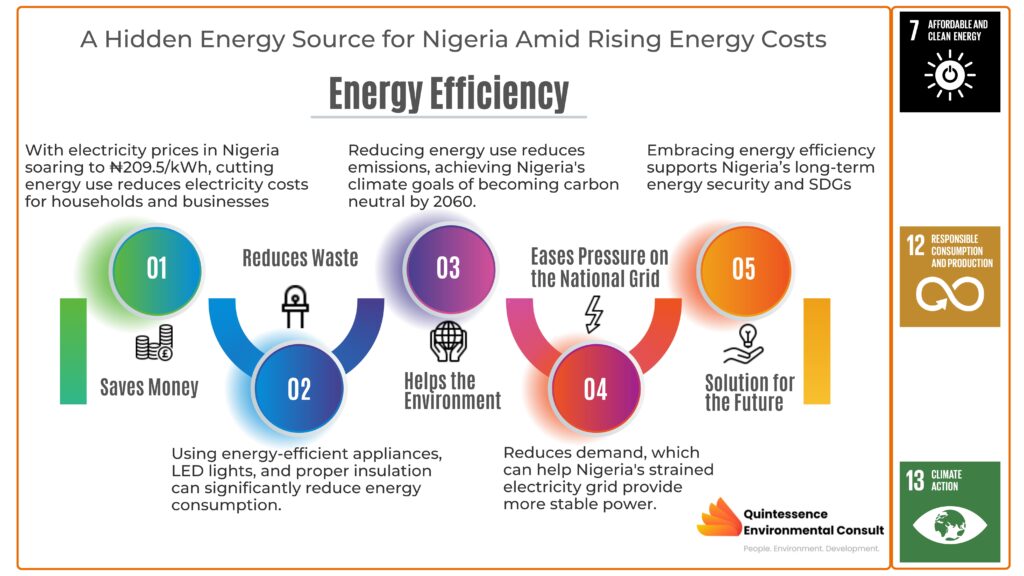
Takeaways: Energy Efficiency Saves Money: With electricity prices in Nigeria rising to ₦209.5 per kWh, using less energy can help lower electricity bills for households and businesses. Energy Efficiency Reduces Waste: Simple changes like using energy-efficient appliances, LED lights, and proper insulation can significantly reduce energy consumption. It Helps the Environment: By reducing energy use, we also cut down on emissions, helping Nigeria achieve its climate goals, like becoming carbon neutral by 2060. Eases Pressure on the National Grid: Energy efficiency reduces demand, which can help Nigeria’s strained electricity grid provide more stable power. Energy Efficiency Is a Solution for the Future: Embracing energy efficiency now will not only save money but also support Nigeria’s long-term energy security and sustainable development goals. Did you know? Did you know that saving energy can be just as powerful as generating it? Think of it this way: every kilowatt of electricity we don’t waste is a kilowatt we don’t need to produce. A brief survey of opinions around the suburbs of Abuja show that many homeowners spend an average of N70,000.00 per month to meet their energy needs. For businesses and other heavy power users, the figure is worse, with many closing shops. Efficient energy use: However, by using energy more efficiently, we’re not just reducing our bills—we’re also reducing the demand on power plants and the overall strain on the electricity grid. It’s like plugging a leak in a water pipe: the more we prevent waste, the less we need to pump. In essence, the energy we save can have just as much impact as the energy we create, helping to make our resources stretch further and work smarter for us. Rising energy prices in Nigeria are driven by various macroeconomic factors, such as fluctuating foreign exchange rates and escalating gas prices. According to the Nigerian Electricity Regulatory Commission (NERC), by July 2024, Band A customers, who are guaranteed 20-24 hours of electricity daily, were paying as much as ₦209.5 per kWh. For many, this hefty cost has become a significant financial burden. With energy costs climbing, Nigeria’s journey toward energy security and economic sustainability should focus on more than just increasing supply—it must prioritize efficiency as well. The International Energy Agency (IEA) projects that energy efficiency could reduce global energy demand by 40% by 2040. In Nigeria, this approach could serve a dual purpose: cutting emissions while also lowering electricity bills and easing pressure on the overstretched national grid. Rising electricity tariff: Electricity tariff in Nigeria has been on a steady rise due to external factors, including the devaluation of the naira and increasing gas prices. As mentioned earlier, Band A consumers now face tariffs of up to ₦209.5 per kWh. In this context, inefficient energy use only exacerbates the financial strain on households and businesses. Small and medium-sized enterprises (SMEs) are especially impacted, as they account for about 70% of industrial jobs and 50% of manufacturing output. Many SMEs still depend on inefficient energy sources, such as diesel generators, which not only inflate operational costs but also harm the environment. By embracing energy-efficient practices, SMEs can cut their energy expenses and contribute to Nigeria’s transition to a cleaner, net-zero future. Energy efficiency options: So, what is energy efficiency? Simply put, it means using less energy to accomplish the same tasks, thus cutting down on waste. Small, simple changes—like switching to energy-efficient appliances, using LED lighting, and improving home insulation—can make a big difference. Table 1 shows examples of energy efficiency measures that can be taken by different sectors of the economy. Consumer Type Energy Efficiency Measures Examples Homeowners Switch to energy-efficient lighting and appliances,improve insulation, and adopt solar/inverter systems. LED bulbs, solar-powered lighting, energy-efficient refrigerators. Small Businesses Use energy-efficient office equipment, LED lighting, and consider solar for power backup. Solar-powered POS, LED office lighting, inverter-based air coolers. Large Corporations Conduct energy audits, upgrade machinery, and invest in renewable energy like solar or cogeneration systems. DC motors, solar panels, energy-efficient HVAC systems. Agriculture Solar irrigation, biogas digesters, energy-efficient milling machines. Drip irrigation systems, energy-efficient greenhouses. Use solar-powered pumps, biogas, and energy-efficient processing machines. Implement precision farming to optimize energy and water use, and use energy-efficient greenhouse technology Retail/Commercial Switch to energy-saving HVAC, LED lighting, and smart meters. Adopt solar for kiosks or small shops. Retrofit building facades with reflective materials to reduce cooling loads. Solar kiosks, smart thermostats, energy-efficient refrigeration. Reflective building facades. Public Sector Install energy-efficient lighting, HVAC, and solar backup systems in institutions like schools and hospitals. Adopt net-zero energy building designs for new public projects LED in schools, solar-powered hospital backups, motion-sensor office lights. Net-zero energy buildings Table 1: Showing Energy Efficiency Measures by Consumer Type in Nigeria By adopting these measures, Nigerian consumers can not only reduce their energy consumption but also lower their energy bills. The World Bank’s Nigeria Power Sector Recovery Plan emphasizes the role energy efficiency can play in stabilizing the country’s electricity sector. By cutting down demand, energy efficiency lightens the load on the national grid, which is already stretched thin. Other benefits: Beyond the obvious cost savings, energy efficiency is critical for Nigeria’s environmental goals. The United Nations Framework Convention on Climate Change (UNFCCC) outlines that Nigeria aims to reach carbon neutrality by 2060. Energy efficiency can be a key driver in reducing greenhouse gas emissions, helping the country align with global sustainability targets. In fact, energy efficiency holds the potential to transform Nigeria’s energy landscape especially if SMEs embrace it. As energy prices continue to rise, it provides a practical, cost-effective solution that benefits both consumers and the environment. For households and businesses, embracing energy-efficient practices can significantly reduce energy bills, relieving some of the financial burden caused by high tariffs. Furthermore, by reducing overall electricity demand, energy efficiency can help address Nigeria’s persistent energy shortages and bolster the country’s energy security. Looking ahead, energy efficiency should not be seen merely as a cost-saving measure. It must be embraced as a strategic approach for Nigeria’s sustainable development objectives. The future