
KEY TAKEAWAYS
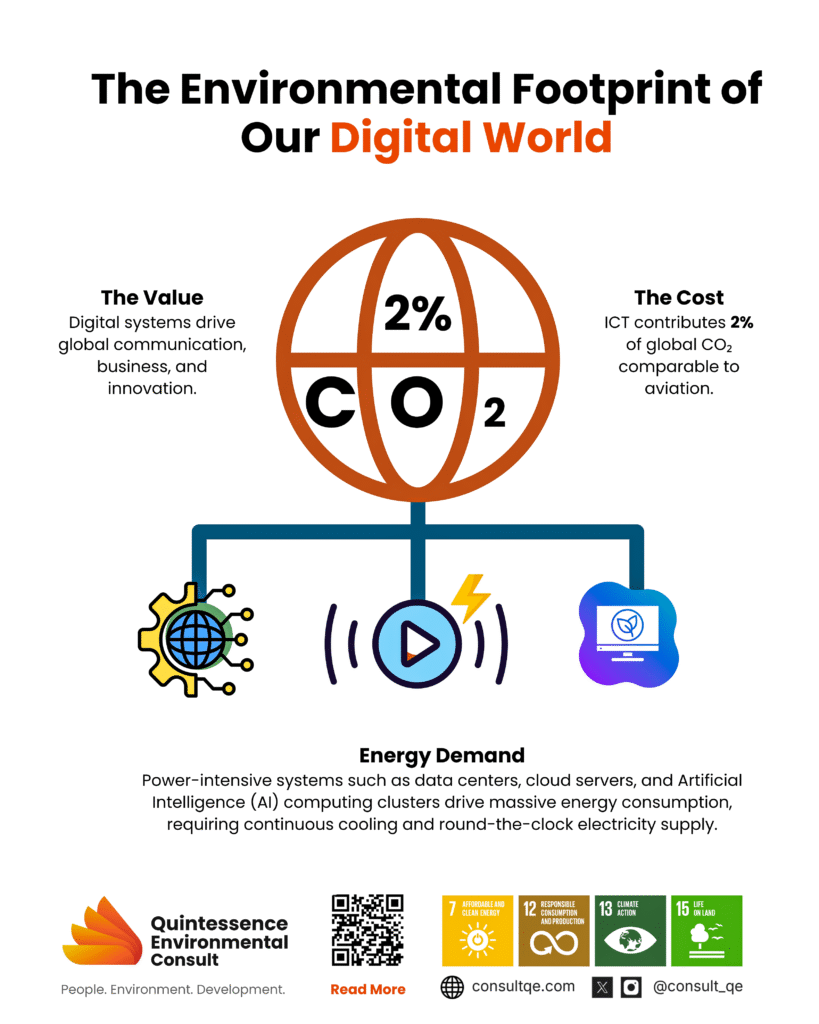
- The Physical Footprint: The Information and Communication Technology (ICT) sector, which fuels our digital lives, has an environmental footprint comparable to the global aviation sector, responsible for nearly 2% of energy-related carbon emissions [1].
- The Extractive Crisis: The production of digital hardware (smartphones, AI chips) drives biodiversity loss by relying on rare earth elements (REEs) mined in ecologically fragile regions, generating up to 2,000 tons of toxic waste per ton of REE extracted [5].
- The Thirst for Data: Data centers, the physical home of the cloud, consume massive water quantities—up to 5 million gallons per day—often in drought-stricken areas, accelerating localized ecological collapse [4].
- The E-Waste Deluge: Electronic waste (e-waste) is one of the world’s fastest-growing waste streams, projected to hit 74 Mt by 2030 [22], resulting in chronic, generational contamination of vulnerable communities [15].
- The Lifeline: Despite its damage, IT is the most critical tool for conservation. AI and Distributed Acoustic Sensing (DAS) are transforming 1 million kilometers of deep-sea fiberoptic cables [13] into a planetary defense system for marine monitoring.
THE DIGITAL PROMISE AND THE PLANETARY COST
The global Information Technology (IT) ecosystem is often perceived as a realm of dematerialization, a transition to intangible data streams that leave no physical trace. This perception, however, masks a profound and destructive physical reality. The massive, interconnected infrastructure that supports our digital world, from colossal data centers to specialized Artificial Intelligence (AI) chips, is constructed upon a foundation of intense resource extraction, astronomical energy demand, and persistent environmental debt [16].
This defines a critical paradox: the very technology designed to connect and advance human civilization is accelerating planetary collapse by becoming a primary driver of biodiversity loss and contamination of soils, waterways, air, and even living organisms through toxic mining waste, chemical leaching, and persistent e-pollutants [16].
The scale of this physical impact is immense. The ICT sector accounts for approximately 1.9% of global greenhouse gas (GHG) emissions [8]. Crucially, data centers and associated transmission networks are responsible for nearly 2% of energy-related carbon emissions [1]—a figure that places the digital economy’s operational footprint on par with the global aviation sector [1]. While air travel attracts intense public scrutiny, the digital realm frequently escapes comparable analysis, revealing a significant disconnect between perceived sustainability and devastating physical consequences [16].
THE ECOLOGICAL DEBT
1. The Extractive Crisis: Balancing Mineral Demand and Ecosystem Protection
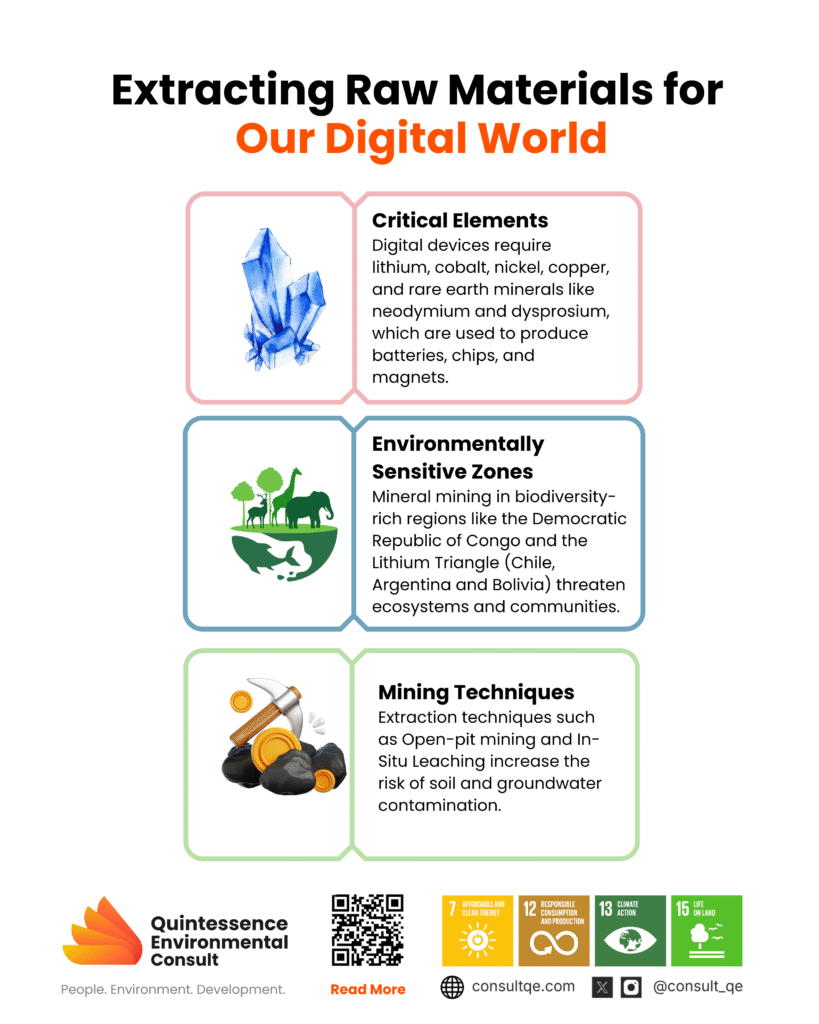
The life cycle of every digital device begins deep underground, often in the world’s most ecologically fragile regions. Essential components for Information Technology (IT) hardware, including smartphones and advanced Artificial Intelligence (AI) processors like Graphics Processing Units (GPUs), rely heavily on critical metals and rare earth elements (REEs) [3]. These deposits frequently overlap with global biodiversity hotspots [16].
The extraction methods—such as open-pit mining and in-situ leaching (ISL)—result in irreversible damage: habitat destruction, soil erosion, and water contamination [16]. This structural coincidence means that the growth of the ICT industry still relies on environmentally sensitive practices.
The consequences of this material sourcing are staggering:
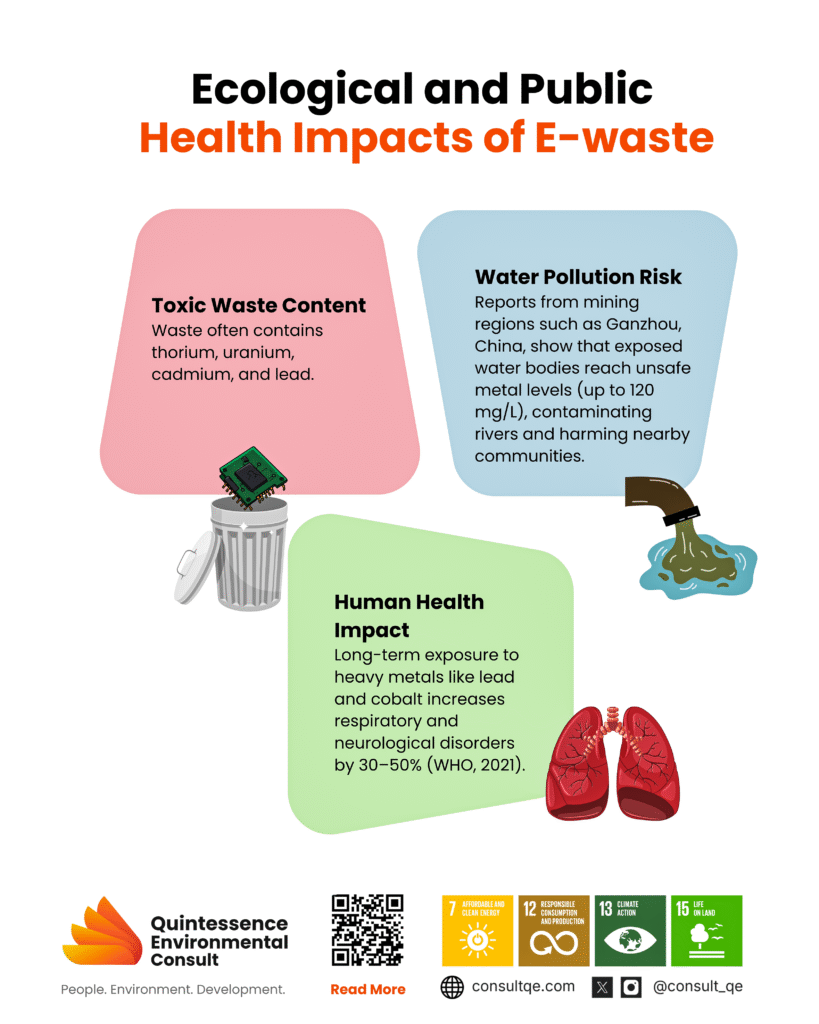
- Toxic Waste Generation: Rare earth mining operations generate up to 2,000 tons of toxic waste per ton of rare earth extracted [5]. These wastes contain radioactive and heavy metals like Thorium, Uranium, Cadmium, and Lead [5], which leach into water bodies, increasing cancer risks, kidney failure, and respiratory disorders among nearby populations.
- Persistent and Perennial Contamination: Poorly managed mine waste leads to pollution of rivers and groundwater, reaching up to 120 mg/L of heavy metals annually in some reported case studies [5]. Long-term human exposure results in neurological damage, developmental delays, and reduced immune function in affected communities.
- The Cobalt Cost: The Democratic Republic of Congo (DRC) holds an estimated 70% of the world’s cobalt reserves [19] a mineral vital for batteries. Its extraction causes severe ecosystem damage, including water and air pollution with toxic dust and grit [14, 2]. The health toll is significant: communities face increased rates of lung fibrosis, skin lesions, and heavy-metal poisoning [24]. This is not merely an environmental crisis; it represents environmental injustice, where biodiversity loss intertwines with human suffering in vulnerable regions [24].
2. The Toxic E-Waste Deluge
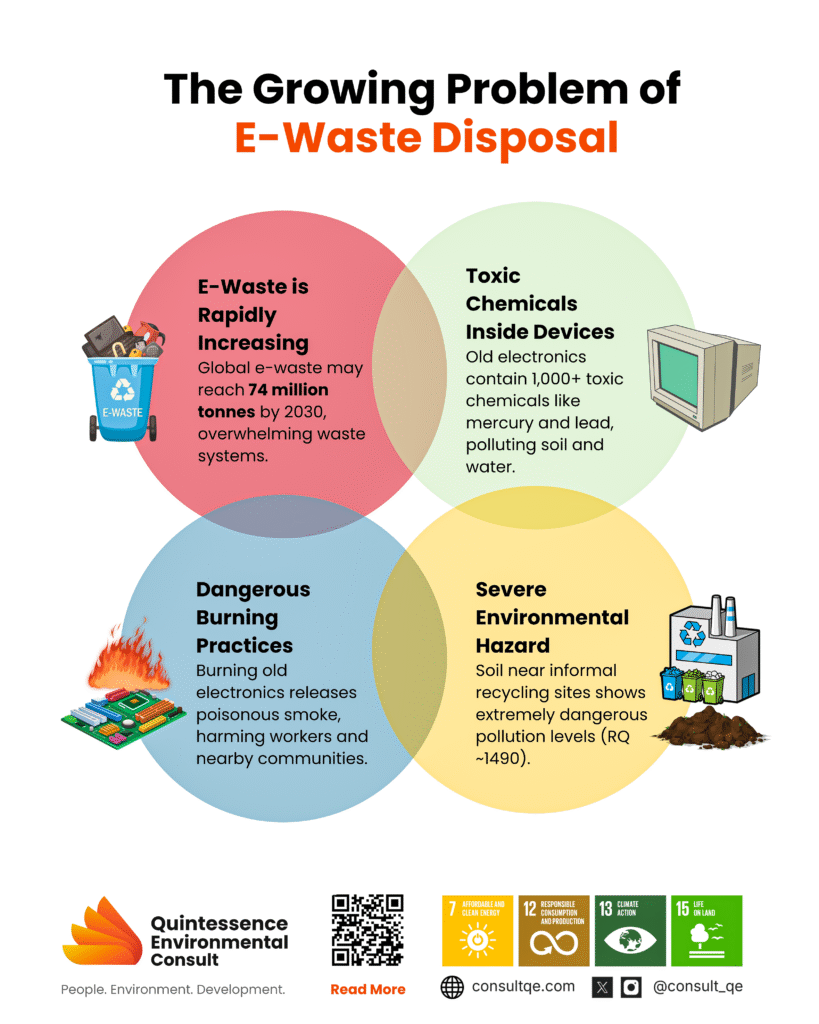
The toxic material flow culminates at the end of the hardware lifecycle as electronic waste (e-waste), which represents one of the world’s fastest-growing waste streams [22]. In 2019, 53.6 metric tons (Mt) of e-waste were generated globally, a figure projected to rise sharply to 74 Mt by 2030 [22].
E-waste is chemically complex, containing over 1,000 substances, including neurotoxicants like mercury and lead [11]. Despite international regulations, millions of tons are shipped across borders, often disguised as used electronics, with West Africa emerging as a major destination [22].
In informal recycling sites like Agbogbloshie in Accra, Ghana, workers burn components to recover metals releasing non-biodegradable pollutants into the air, soil, and water [15]. This process emits dioxins, furans, and polycyclic aromatic hydrocarbons (PAHs), which cause severe respiratory issues, endocrine disruption, and elevated cancer risks.
The synergistic toxic effect of these contaminants is alarming; risk quotients (RQ) for certain organophosphate flame retardants, such as triphenyl phosphate, register at RQ = 1490 [10], indicating extremely high ecological and human health risk. Vulnerable populations, especially children, are disproportionately exposed [21], resulting in neurodevelopmental damage, hormonal imbalance, and impaired cognitive growth [23].
3. Data Centers and Water Conflict
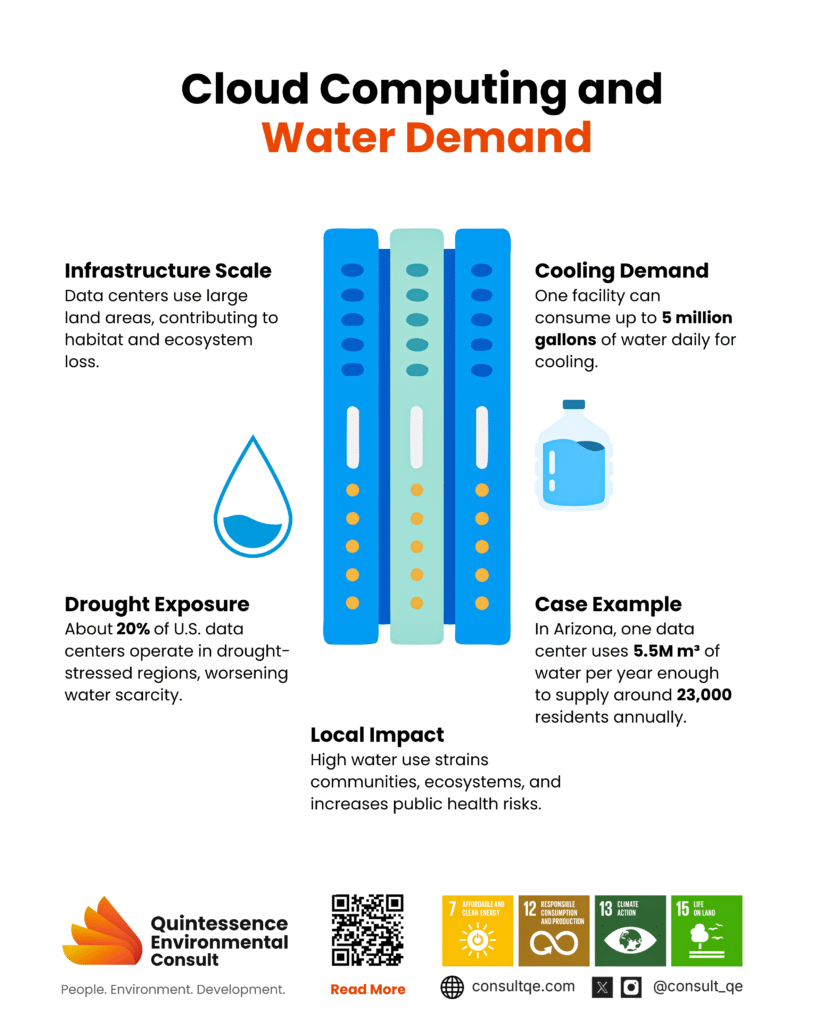
The physical footprint of the IT industry extends into the very architecture of the internet: the data center. These sprawling facilities, which host the cloud and AI [17], demand vast quantities of land, energy, and water—often extracted from drought-prone regions.
- Land Use and Habitat Loss: Data centers, like the 327-acre facility in Oregon [3], displace ecosystems and fragment habitats. Such disturbance fosters dust pollution and microbial imbalance, leading to respiratory ailments among nearby residents.
- Water Consumption: Evaporative cooling systems consume up to 5 million gallons of water per day [4]—equivalent to the daily use of a small town. These withdrawals reduce water availability for local populations and agriculture, contributing to dehydration-related illnesses, food insecurity, and heat stress [1, 17].
- Localized Ecological Debt: About 20% of U.S. data centers operate in drought-stressed regions [1]. In Mesa, Arizona, Google’s data center uses 5.5 million cubic meters per year, enough for 23,000 people [18], while Amazon’s proposed site in Aragon, Spain—75% desertification-prone—draws 755,720 cubic meters annually [18]. Such consumption intensifies water scarcity, sanitation challenges, and vector-borne diseases in nearby communities.
Although companies pledge to be “water positive” by 2030, their offsetting measures providing water elsewhere, ignore localized health impacts. As experts note, carbon is global, but water is local [18]. Depleting aquifers accelerates environmental degradation, raising heat stress, infectious disease spread, and socio-economic displacement in drought-affected zones [18].
THE DIGITAL LIFELINE: IT AS A CONSERVATION FORCE MULTIPLIER
From precision agriculture and smart transportation to medical breakthroughs, global connectivity, and real-time disaster response systems, information and communication technologies (ICTs) have become central to human progress. They enable faster data-driven decision-making, environmental monitoring, scalable education, and economic growth across every sector. Digital tools power climate science, accelerate sustainable energy deployment, and connect communities previously left behind.
Yet, alongside these enormous societal benefits lies a profound ecological footprint. Despite this environmental debt, the same technology that contributes to biodiversity pressure also holds unparalleled potential to become the world’s most powerful conservation tool.
- AI as the New Forest Ranger: Artificial Intelligence is proving instrumental in tackling the illegal wildlife trade (IUWT), which is considered the second biggest threat to wildlife after habitat loss [20]. AI-powered systems monitor rhino populations [12], detect poaching threats in Africa, and use “nowcasting” models to disrupt trafficking routes [6].
- Emerging Remote Sensing Technology and IOT: For protecting habitats, remote sensing technology is indispensable. Global forests cover 31% of the planet’s land area [9], and their destruction accounts for about 10% of global emissions [9]. AI algorithms analyze satellite imagery, including Synthetic Aperture Radar (SAR), to identify deforestation and illegal logging hotspots across massive areas, enabling immediate intervention to protect species like the orangutan [7,12].
- The Acoustic Revolution: The most transformative innovation is the repurposing of existing digital infrastructure. Distributed Acoustic Sensing (DAS) leverages the world’s existing communications network. This technology repurposes over 1 million kilometers of deep-sea fibre-optic cables, [13] infrastructure built for telecommunications to function as vast underwater sensor arrays. By analyzing how sound affects light in these cables, DAS detects real-time acoustic signals from marine species (whales, seals, fish) and human activities (shipping, deep-sea mining), transforming a liability into a low-cost, global planetary defence system [13].
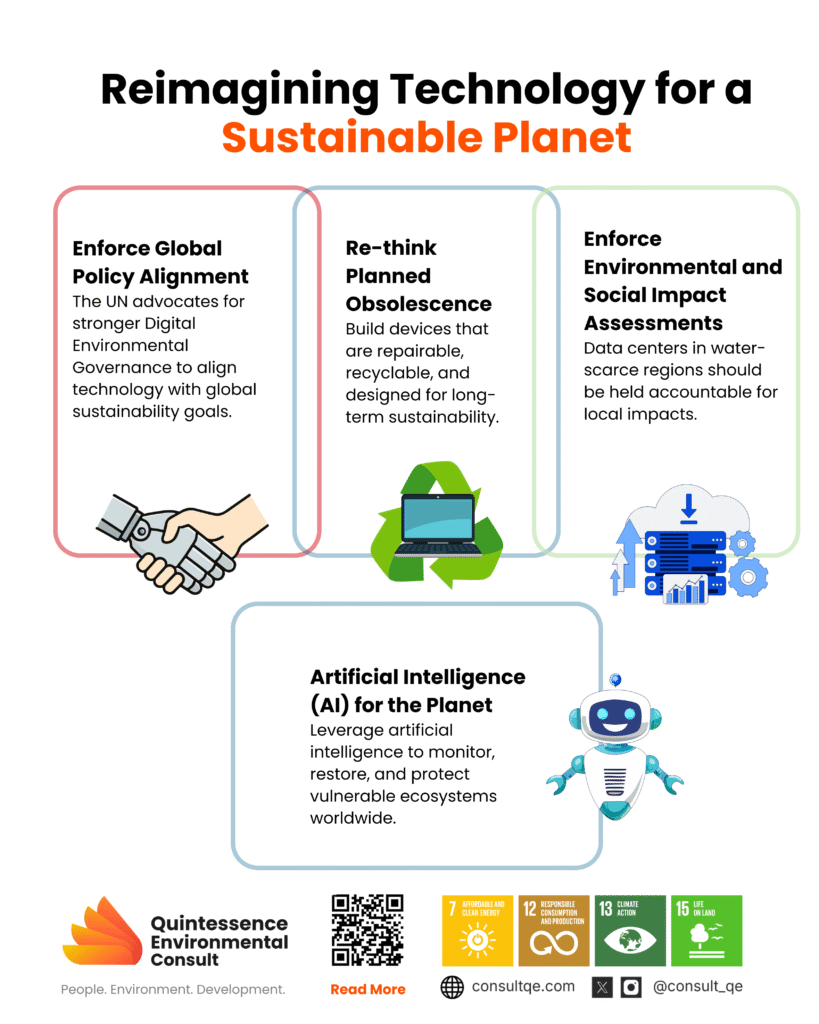
- Mandate Material Circularity: Hardware must be redesigned for longevity and non-toxicity, eliminating the use of non-biodegradable components to end the generational contamination posed by toxic tailings waste [5].
- Enforce E-Waste Governance: Strict enforcement of agreements like the Basel Convention is required to eliminate the illegal shipment of e-waste [22], which currently burdens vulnerable developing regions and accelerates localized ecosystem collapse23.
- Implement Geospatial Governance: Governments should enact policies requiring mandatory Water Stress Index (WSI) assessments before approving data center construction. This prevents the placement of high-consumption infrastructure in drought-stressed regions and replaces misleading “water positive” global offsetting claims with localized accountability [18].
- Invest in the Digital Lifeline: Finally, the immense technological capacity of the IT sector must be deliberately leveraged. Incentivizing the application of AI, remote sensing, and dual-use infrastructure like DAS represents the most promising path toward transforming the digital economy from an environmental liability into a critical planetary defense system [13].
The path forward requires the tech industry and its consumers to accept that every click, stream, and piece of hardware carries an ecological debt. Addressing the Digital Paradox demands not merely efficiency, but a fundamental ethical shift, pairing technological progress with rigorous environmental governance and material responsibility.
- David Suzuki Foundation. How to reduce your digital carbon footprint. https://davidsuzuki.org/living-green/how-to-reduce-your-digital-carbon-footprint/
- Earth.org. Cobalt mining in Congo. https://earth.org/cobalt-mining-in-congo/
- Eastgate. Environmental Impact of AI: Uncovering the Hidden Costs (2025). https://medium.com/@eastgate/ environmental-impact-of-ai-uncovering-the-hidden-costs-8bf605bec401
- EESI. Data Centers and Water Consumption. https://www.eesi.org/articles/view/data-centers-and-water-consumption
- Farmonaut. Environmental Impacts of Rare Earth Mining: 7 Challenges (2025). https://farmonaut.com/mining/ environmental-impacts-of-rare-earth-mining-7-challenges
- Frontiers in Ecology and Evolution. The rising tide of conservation technology (2025). https://www.frontiersin.org/journals/ ecology-and-evolution/articles/10.3389/ fevo.2025.1527976/pdf
- Frontiers in Forests and Global Change. Deep learning methods for automated deforestation detection. https://www.frontiersin.org/journals/forests-and-global-change/articles/10.3389/ffgc.2024. 1300060/full
- Greenly Earth. The Carbon Cost of Streaming. https://greenly.earth/en-us/leaf-media/data-stories/the-carbon-cost-of-streaming
- Iceye. Deforestation and Forest Degradation Monitoring with SAR Satellite Imagery. https://www.iceye.com/blog/deforestation-and-forest-degradation-monitoring-with-sar-satellite-imagery
- MDPI. E-waste microplastics and ecological risk. https://www.mdpi.com/2076-3298/11/2/30
- MDPI. Electronic waste toxic substances contamination soil water biodiversity impact. https://www.mdpi.com/2071-1050/16/11/4347
- Medium. AI in Wildlife Conservation: Protecting Endangered Species. https://medium.com/@futureaiweb/ai-in-wildlife-conservation-protecting-endangered-species-with-intelligent-systems-c14e3ffd2e64
- Oxford Biology. Revolutionising conservation with AI (Distributed Acoustic Sensing). https://www.biology.ox.ac.uk/article/ revolutionising-conservation-with-ai
- PMC. Cobalt mining in Congo and its environmental and social impacts. https://pmc.ncbi.nlm.nih.gov/articles/ PMC9277192/
- PMC. Hazardous pollutants from e-waste. https://pmc.ncbi.nlm.nih.gov/articles/ PMC8674120/
- Rare Earth Mining Impacts. The Impacts of Rare Earth Mining for Our Digital World on Biodiversity (2025). https://www.societybyte.swiss/en/2025/01/ 31/the-impacts-of-rare-earth-mining-for-our-digital-world-on-biodiversity/
- Stanford. AI Crunching Data Centers Sprout across the West. https://andthewest.stanford.edu/2025/thirsty-for-power-and-water-ai-crunching-data-centers-sprout-across-the-west/
- The Guardian. Big Tech datacentres are draining the world’s most drought-hit areas of water (2025). https://www.theguardian.com/environment/ 2025/apr/09/big-tech- datacentres-water
- UNEP. Can the Democratic Republic of Congo’s mineral resources provide a pathway to peace?. https://www.unep.org/news-and-stories/story/can-democratic-republic-congos-mineral-resources-provide-pathway-peace
- USC. Illegal wildlife trade is a major driver of biodiversity loss. https://viterbischool.usc.edu/news/2025/06/
researchers-uncover-hidden-airport-hotspots-in-global-wildlife-trafficking-using-ai/ - USFCA. Environmental justice in e-waste recycling areas. https://pmc.ncbi.nlm.nih.gov/articles/ PMC10815197/
- VoxDev. Electronic waste: A silent killer in West Africa. https://voxdev.org/topic/health/electronic-waste-silent-killer-west-africa
- WHO. Electronic Waste (E-Waste). https://www.who.int/news-room/fact-sheets/detail/electronic-waste-(e-waste)
- WWF. WWF releases a study on Mining and Biodiversity Conservation in the Congo Basin (2017).((https://wwf.panda.org/wwf_news/?315890/WWF%2 Dreleases%2Da%2 Dstudy%2Don%2 DMining%2 Dand%2D Biodiversity%2D Conservation% 2Din%2Dthe%2 D Congo%2DBasin)